


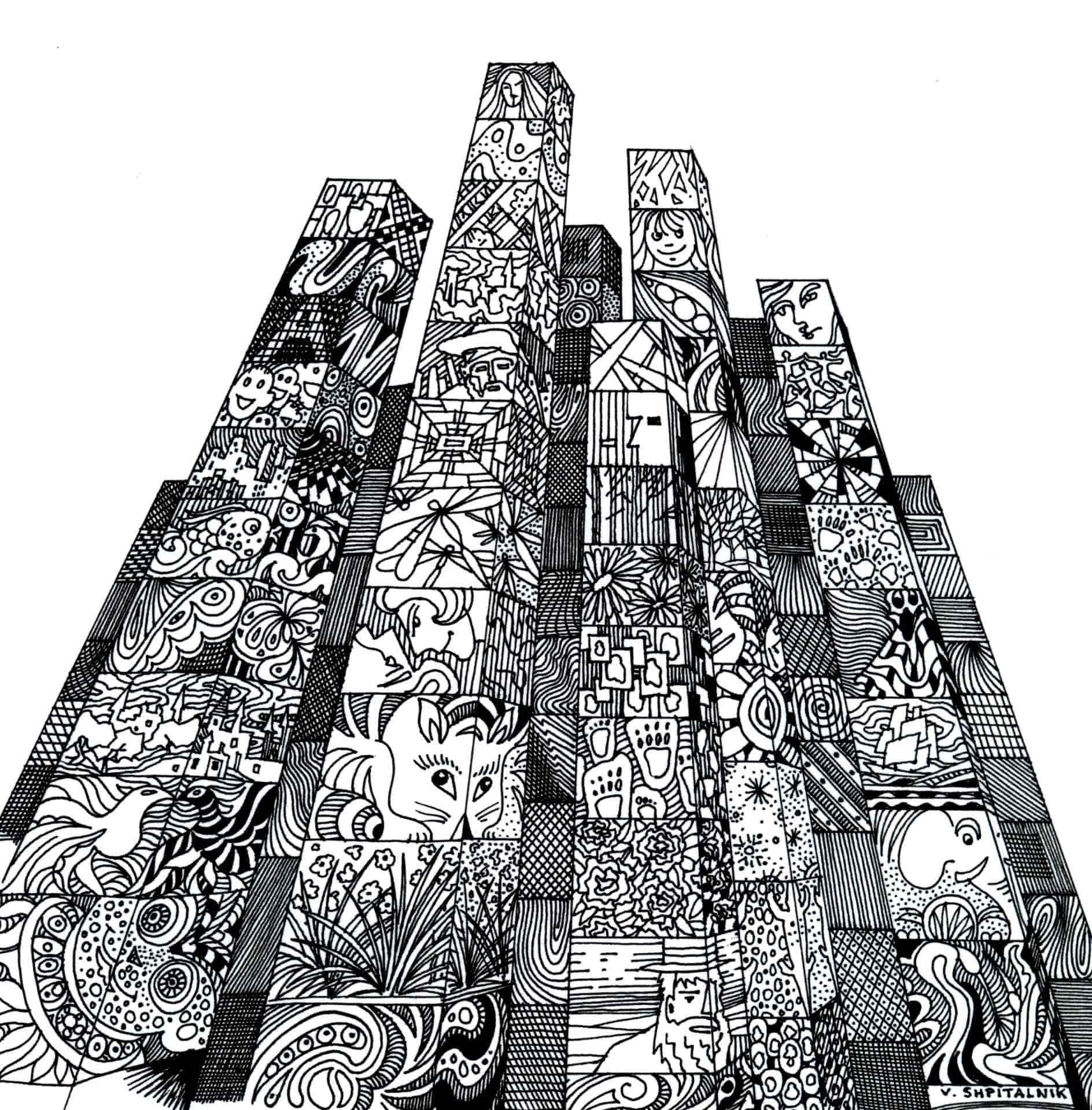


Public Art & Murals for New England and the New York Region
Public art changes the way a place is experienced. A wall can become a story, a familiar street can reveal an unexpected image, and a sculpture can give people a reason to stop and look again. I’m Vladimir Shpitalnik, an artist, theater designer, and educator based in Connecticut. My practice includes murals, public art, monumental wooden sculptures, paper sculpture, illustration, and painting. This page brings together public projects from my portfolio and introduces the ideas behind them. If you are planning an artwork in Massachusetts, Rhode Island, New Jersey, or New York, these examples offer a starting point for a conversation. For organizations in New York City, including those searching for a public artist in NYC, the same question matters: what should this particular place communicate? My approach begins with imagination, setting, and audience, rather than a formula that could be placed anywhere.
A Theatrical Approach to Site-Specific Art
Theater has influenced the way I see the world throughout my life. I think of a space as a setting in which images, objects, materials, and people can interact. This perspective connects my public art with my set and costume design, fine art, and illustration. Each medium performs differently. A large wooden figure has a presence that changes as a visitor walks around it; a mural builds its story across a surface; a paper construction creates depth through layers, light, and shadow. The purpose is not to make every project look theatrical in the same way. It is to recognize how an artwork becomes part of an experience. For a community space, cultural venue, or public-facing interior, that experience may involve curiosity, recognition, surprise, or a sense of shared place. The surrounding architecture and the way people approach an artwork are therefore meaningful parts of the artistic conversation.
International Festival of Arts and Ideas
The International Festival of Arts and Ideas appears in the “I’ve worked with” section of my website and in the public art portfolio. The works shown include Drama Puppet, Children’s Theater Puppet, and Jazz Puppet, alongside the 500 Faces project and its proposal. These examples connect sculpture, performance, and a public audience in New Haven. Their character is visible in their scale, expressive shapes, and invitation to engage with an imagined world. They also show why public art is not limited to an image on a wall. A figure, an installation, or a group of objects can establish a meeting point between visual storytelling and everyday surroundings. When considering a new commission, these projects can help clarify whether the desired experience is playful, contemplative, celebratory, or narrative. The portfolio captions identify the individual works; the festival reference describes an existing professional connection, not an endorsement of a future project.
Murals: 101 College Street, New Haven
The mural at 101 College Street in New Haven is another documented project in my public art portfolio. Its photographs show an artwork experienced both as a broad composition and as part of a larger architectural setting. That relationship is central to thinking about murals. A visitor may first encounter a wall from a distance and then discover individual colors, shapes, and passages while moving closer. The visual language must work at more than one scale. For someone exploring a mural commission in Massachusetts or Rhode Island, the useful lesson is to consider the actual wall and its surroundings before choosing an image. For an organization in New Jersey or New York, it is equally important to ask how the work will be seen during ordinary use of the space. Photographs, approximate dimensions, and a description of the intended audience are helpful starting materials for discussing the artistic direction.
The Shubert Theater and Griffin Hospital
My portfolio includes the Centennial Celebration at the Shubert Theater in New Haven and Carnival of the World at Griffin Hospital in Derby. These are different settings, yet both demonstrate how artwork can respond to a place with its own identity and audience. A theater carries associations of performance and collective memory. A hospital is experienced by people with many different reasons for being there. These contexts suggest different questions about imagery, atmosphere, scale, and emotional tone. They should not be treated as interchangeable backdrops. The Shubert Theater is also named in “I’ve worked with” on the home page. Looking at these existing works can help a prospective commissioner explain what they value: a connection to architecture, an imaginative subject, a recognizable local reference, or an environment that offers visual discovery. A new proposal would need to be considered on its own terms rather than copying a previous project.
Public Art Conversations in Massachusetts and Rhode Island
For an organization researching public art in Massachusetts, or a mural artist for a Rhode Island project, the portfolio provides concrete examples of my broader creative practice. My Connecticut base is part of that context; the website does not present offices or completed projects in every state mentioned here. Regional inquiries are an opportunity to discuss a particular site, not a claim that the same artwork or installation method suits every location. A useful initial brief might explain whether the setting is outdoors, inside a building, or somewhere between the two, such as a publicly accessible entrance. It can describe who uses the space, what they should notice, and whether there is an existing story to explore. From there, the discussion can focus on artistic fit. The most productive references are often specific: a sculpture from this portfolio, the visual rhythm of the College Street mural, or the storytelling of Carnival of the World.
New Jersey, New York, New York City and NYC
New York is both a state and a collection of very different local settings. New York City, often shortened to NYC, adds its own variety of streetscapes, interiors, and cultural spaces. New Jersey also offers many distinct architectural and community contexts. For a public art inquiry in any of these areas, a regional label is less informative than an understanding of the place itself. A work intended for a busy entrance raises different artistic questions from one intended for a quieter gathering space. An interior mural may need a different relationship to viewing distance than a freestanding figure. If you are searching for murals in NYC or a public art commission in New Jersey, please use the documented portfolio as a reference for the kind of imagination and material exploration I bring. The location, scope, practical requirements, and suitability of any new collaboration remain matters for direct discussion.
Yale University and a Multidisciplinary Background
Yale University, Yale Cabaret, Joffrey Ballet, Moscow Art Theatre School, Metinteractive, Oakdale Theater, Cambridge University Press, and Alfred A. Knopf are among the names shown in “I’ve worked with.” Together with the festival and Shubert references, they reflect a practice that crosses theater, education, illustration, and visual art. They should not all be read as public art clients or attached to a particular mural. My biography provides additional context: I earned an MFA in Set and Costume Design from the Yale School of Drama and studied at the Moscow Art Theater. Earlier ceramics studies at the Abramtsevo Art School contributed to an exploratory relationship with materials. These experiences support a way of working that moves between image and object, small detail and large environment. When looking at a public artwork, that background can be understood through its composition, storytelling, and attention to the experience of an audience.
Discuss a Public Art or Mural Commission
A public art inquiry does not need a fully resolved design. It can begin with a place, a question, and an intention. Please share the project location, the kind of space involved, and any photographs or dimensions already available. If there is an anticipated schedule or budget range, including that information will make the first conversation more focused. You may also identify the works on this page that connect with your goals and explain why: their imagery, scale, atmosphere, or use of materials. Questions about permissions, fabrication, installation, and ongoing care should be considered in relation to the actual proposal and the people responsible for the site; this page does not substitute for that planning. Whether your inquiry comes from Massachusetts, Rhode Island, New Jersey, New York, or NYC, the aim is a meaningful connection between artwork and setting. Use the contact form below to introduce the project and begin a conversation.
Look Beyond a Single Photograph
When reviewing the gallery, compare close views with photographs that include the surrounding space. Notice how a figure relates to a person, how a composition extends across a wall, or how a repeated architectural motif creates a larger scene. These observations can help turn an initial preference into a useful brief. You do not need to know the right artistic terminology. Describing what you see and how you hope people will feel is often more valuable. Public art becomes specific when the conversation moves from an attractive image toward a clear relationship between the work, its setting, and the people who encounter it.